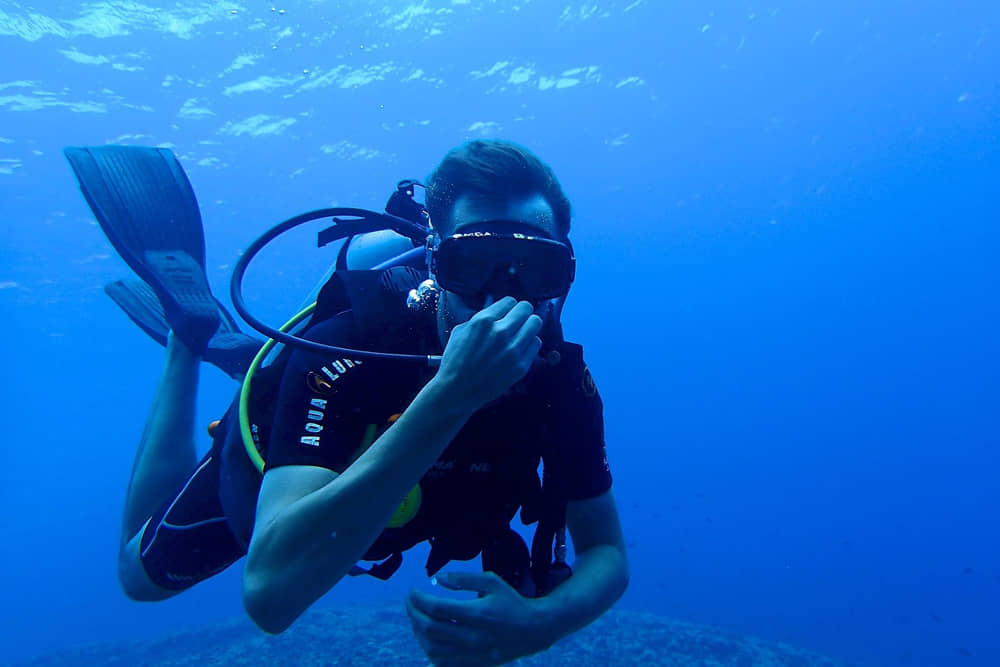

Decompression in diving is the process of letting your body release the nitrogen it absorbed under pressure, by controlling the speed of your ascent and pausing on the way up. Every dive involves decompression. On a recreational dive it happens quietly: you ascend no faster than about 10 metres per minute and add a safety stop of three to five minutes at around five metres. If the pressure drops too fast, that dissolved nitrogen can come out of solution as bubbles and cause decompression sickness.
In short
Decompression in diving is the process of letting your body get rid of the excess gas it absorbs during a dive, especially a deep one. The air you breathe underwater contains nitrogen, that nitrogen dissolves into your bloodstream under pressure, and it has to leave the body gradually. If you go straight up to the surface without controlling the ascent, the nitrogen can form bubbles inside you and cause decompression sickness.
In practice it comes down to two actions: ascend slowly and make the safety stops your plan calls for, usually a few minutes near the end of the dive. Boyle's law explains why: as you descend, pressure rises and gas volume shrinks; as you ascend, pressure drops and that gas expands again. Dive computers track your depth and time in real time, calculate your limits and warn you if you are going up too fast; decompression tables do the same job on paper, giving maximum bottom times per depth and the stops required.
The rest is habit. Plan depth, time and stops before you get in the water, respect surface intervals between dives, stay hydrated, keep your gear in good condition and watch your depth and time throughout the dive. If someone shows joint pain, breathing difficulty, chest pain or neurological symptoms after a dive, that is a medical emergency: oxygen and treatment in a hyperbaric chamber, as fast as possible.
That single idea is behind almost every rule you learn in a diving course: why you plan depth and time before you get in, why you keep an eye on your computer, why you wait between dives and why you do not fly straight after diving. Below we go through the physics, the numbers, the tools that do the maths for you and the difference between staying inside the no-decompression limits and deliberately going beyond them.
What decompression actually means
Decompression is simply the reduction of ambient pressure as you come back up, together with the elimination of the inert gas your tissues absorbed while you were down there. Divers often call that elimination offgassing: the nitrogen travels back from the tissues to the blood and leaves through your lungs, breath by breath.
Because it depends on breathing gas at ambient pressure, it only applies to scuba and surface-supplied diving: a freediver on one breath never loads up inert gas the same way.

Why nitrogen is the problem
The air in your tank is roughly 78% nitrogen, a gas your body does not use. Under pressure it dissolves into blood and tissues in proportion to how deep you are and how long you stay. That part is harmless while the pressure holds.
The trouble starts on the way up. Boyle's law explains the mechanism: pressure and gas volume move in opposite directions, so as pressure falls the gas expands. If it expands faster than your circulation can carry it to the lungs, it separates into bubbles inside tissues and blood vessels. That is decompression sickness, and it is the reason ascent speed matters more than almost anything else in your dive plan.
Pressure and depth
Every ten metres of seawater adds roughly one atmosphere of pressure. At 10 metres you are at about 2 ATA, at 20 metres about 3 ATA, at 30 metres about 4 ATA. Your body absorbs nitrogen faster the deeper you go, which is why deep dives run out of no-decompression time so quickly.

No-decompression limits: the line recreational diving stays inside
Recreational diving is built around the idea that you should always be able to ascend directly to the surface, at a controlled speed, without an obligatory stop. The maximum time you can spend at a given depth and still do that is the no-decompression limit, or NDL.
The NDL shrinks fast with depth. In round numbers, a first dive of the day around 18 metres gives you close to an hour, while at 30 metres you are typically down to something like twenty minutes, and repetitive dives cut those figures further because you start with residual nitrogen on board. The exact values change from one table or algorithm to another, so the only number that counts on a given dive is the one your own computer is showing you.
Your safety stop is not part of that limit, which is exactly the point: it is an extra margin you add on top, not a stop you are forced to make.
Ascent rate and safety stops
Two habits do most of the work of a good decompression profile, and both are free.
Modern computers may use variable rates that slow down as you approach the surface, and some display a deep stop of a couple of minutes at around half your maximum depth. Research on deep stops is not unanimous, so follow whatever your computer and your training tell you rather than improvising a profile of your own.
- Ascend slowly. The widely used ceiling is 10 metres per minute from depths below six metres — roughly the speed of your own smallest exhaled bubbles.
- Make the safety stop. Three to five minutes at three to six metres, on every dive, even when nothing obliges you to.
- Keep the last few metres slowest of all. That is where the relative pressure change is biggest and where gas expands most.
Learn to dive with us
Learn to manage your ascents
Our Advanced Adventurer course adds deep and navigation dives in small groups, so you practise ascent control and safety stops with an SSI instructor beside you.
How computers and tables do the maths
Decompression planning is a modelling problem, and it has a long history. J. S. Haldane published the first recognised model in 1908; Albert Bühlmann revised the acceptable supersaturation ratios in 1984, and his work still underpins most recreational computers. Later approaches such as VPM and RGBM model the behaviour of microbubbles rather than dissolved gas alone, and navies and commercial operators maintain their own tables, revised repeatedly over the decades.
What all of them share is the idea of tissue compartments: imaginary tissues that take up and release gas at different speeds. Modern computers track up to sixteen of them simultaneously, recalculating your limits second by second from your actual depth and time.
Printed tables do the same job on paper, giving maximum bottom times per depth and any required stops, and they still matter as a backup and as a way of understanding what the computer is doing. Tables vary by agency and model, so never mix data from two different systems in one plan.
The gear that keeps you inside the plan
You do not need much, but it has to work: a dive computer, a depth gauge and timer as backup, a well-set-up BCD with correct weighting — most fast ascents are buoyancy problems, not decision problems — an SMB and reel so you can hold a mid-water stop and stay visible to the boat, and exposure protection that matches the water.
Recreational diving versus decompression diving
In everyday recreational diving you stay inside the NDL and treat any stop as optional insurance. Decompression diving is the deliberate opposite: you exceed the no-decompression limit to buy more bottom time, and in exchange you accept a mandatory ceiling — you are no longer free to surface directly.
That changes everything about the dive. Planning software replaces mental arithmetic, gas is carried in redundant supplies, the team plans for a failure at the worst possible moment, and ascents are staged with mixes richer in oxygen to speed up offgassing. Open-circuit recreational practice keeps oxygen partial pressure at or below 1.6 bar, which is why pure oxygen is only breathed in the last six metres.
None of that is something to improvise. It belongs to technical training, built level by level on top of solid recreational experience, and it starts with being genuinely comfortable inside the recreational envelope first.
After you surface: intervals, repetitive dives and flying
Surfacing does not end the process. Your body can take up to 24 hours to return to normal inert-gas levels, and that residual load is why every repetitive dive has a shorter NDL than the one before it. Respect the surface interval your plan calls for and let your computer carry the accounting.
Flying compresses the problem, because cabin pressure is lower than at sea level. Common guidance is to wait around 12 hours after a single no-stop dive, 18 hours after repetitive no-stop diving on air or nitrox, and 24 hours or more after dives that involved decompression stops. If your trip ends with a flight, plan the last diving day around it rather than the other way round.
The rest is habit: stay hydrated, avoid hard exercise straight after diving and keep your gear serviced.
Warning signs and what to do
Decompression sickness can appear within minutes of surfacing or several hours later. The symptoms divers are taught to watch for include joint or limb pain, unusual fatigue, skin rash or mottling, dizziness, numbness or tingling, difficulty breathing, chest pain and any neurological sign such as weakness or confusion.
Treat any of them after a dive as an emergency rather than as something to sleep off. The standard response is to stop diving, give oxygen if it is available and trained hands are present, and contact emergency services and a diving medical service immediately; treatment usually involves oxygen and recompression in a hyperbaric chamber, and how quickly it starts makes a real difference. This article is general information, not medical advice: anything involving your own fitness to dive is a conversation for a doctor with diving experience.
Cold water deserves a mention here too. Keeping warm costs energy, which raises air consumption and fatigue; in warm water the effort is lower and recovery after the dive is usually easier. That is one of the reasons tropical destinations are such comfortable places to build experience.
Where to learn this properly
Everything above is taught in the water, not from an article. The SSI Open Water course covers pressure, nitrogen, ascent control and safety stops from the first day, over three days including open water dives to 18 metres. If you are already certified, the Advanced Adventurer course adds deep and navigation dives where you practise ascent control with an instructor beside you, and the advanced course range takes it further with deep, nitrox and stress and rescue.
All our courses are certified by SSI and run at our schools in Thailand and Indonesia, in small groups and warm, clear water. For the other half of the pressure story, see our guide on how to avoid barotrauma while diving.
Plan your dives
FAQ
Frequently asked questions
What is decompression in diving?
It is the process of gradually eliminating the nitrogen your body absorbs during a dive, by ascending slowly and making the stops your dive plan requires.
Why does nitrogen cause problems?
Nitrogen from the air you breathe dissolves into the bloodstream under pressure, and if you surface too quickly it can form bubbles in the body and trigger decompression sickness.
What is a safety stop?
A pause of a few minutes during the ascent that lets the body release the accumulated nitrogen gradually. It is an essential part of any decompression profile.
Computer or decompression tables?
A dive computer monitors depth and time in real time and calculates limits and stops automatically; tables give maximum times per depth and required stops, and vary by agency and model.
Does water temperature affect decompression?
In cold water the body spends more energy staying warm, which raises air consumption and fatigue; in warm water the effort and consumption are lower and recovery after the dive is usually easier.